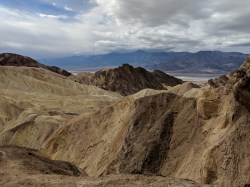
For our daughter’s “Ski Week” break from school in February we headed to Death Valley. We’ve been to most of the other major national parks in California (Yosemite, Sequioa, Kings Canyon, Joshua Tree, and Pinnacles), so we thought it was finally time to visit it. And given that the lows in the summer can be over 100, February seemed like a good time to do it. Also after the rainy winter we’ve been having in the Bay Area, going someplace dry seemed like a great idea.
We thought about driving (we’ve driven to Joshua Tree and the Grand Canyon previously), but given that it’d take over 8 hours to drive there from here and only 2 hours to drive there from Vegas, we opted to hop a short flight to Vegas and rent a car. Overall the worked out pretty well; Southwest has enough cheap flights to Vegas that it was easy to make the timing work out.
For our stay in the park we opted for the Ranch at Death Valley. While it can be cheaper to stay outside of the park (and the accomodations can be nicer), it’s hard to beat the convenience of staying in the park itself, rather than having to drive in and out every day. And the Ranch turned out to be nicer than I expected; Xanterra had recently refurbished it. There were a couple of restaurants and a general store within the Oasis complex, so it was easy to walk to meals and also to buy food to take on hikes. The Oasis is looked in Furnace Creek within the park, which is within a 30 minute drive of many of the major sites within the park.
I like visiting the desert; there’s sonething beautiful about the stark landscape. I think one of the things that surprised me about Death Valley was the variety of habitats that you could visit and hike though in the park. On our trip to Joshua Tree, there were really only two habitats: the Mojave and Sonoran deserts. But in Death Valley you could hike through a badlands region, then drive 10 miles and hike through salt flats, then drive 20 miles and hike a salt marsh (complete with pupfish), then drive another 10 miles and find yourself walking through sand dunes.
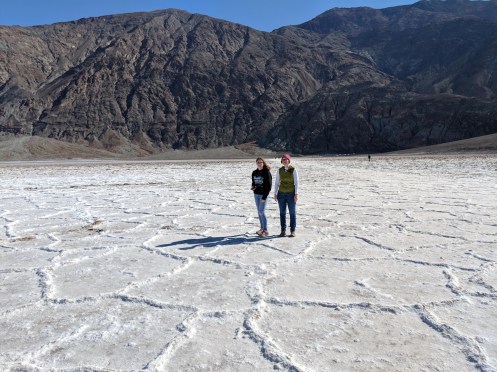
The primary salt flats the most people walk out onto are near Badwater Basin, the lowest point in North America at 282 feet below sea level. It’s a little surreal; it looks like you’re walking out into a snow field, but in reality it’s primary sodium chloride (it was very tempting to taste it, but I have to confess that I couldn’t quite bring myself to do it).

The most popular hike in the park is Golden Canyon. It’s really close to Furnace Creek, and it’s relatively easy with some nice views. It’s also where some of the scenes from Star Wars Episode IV were filmed (Tatooine scenes, obviously). There are a number of regions in the park that served as filming locations, actually; it was fun to figure out which areas looked familiar.
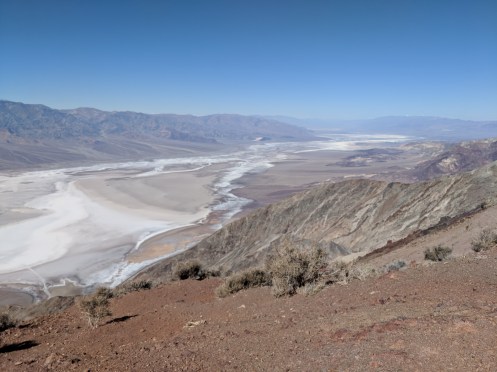
The view from Dante’s View down into Death Valley served as the overlook of Mos Eisley in the film. At over 5000 feet it had great views of the valley and the Panamint mountains across it. We’d planned on hiking the ridge, but hadn’t quite reckoned on the temperature difference between the valley and the ridge; it was close to freezing. So we opted for a hike a bit lower down (and out of the wind) instead.
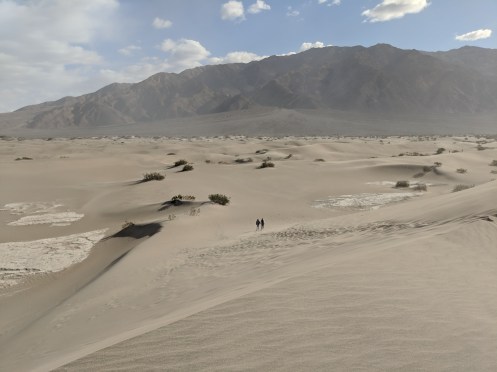
One of the hikes we did was in the Mesquite Flat Dunes. There wasn’t a trail; you just struck out into the dunes in the direction you wanted to go. I felt like I should have brought the overture to Lawrence of Arabia to listen to, but sadly we had to make do with the hissing of the sand in the wind instead. And the wind did blow the sand everywhere. Still, it was totally worth it to feel a bit like a desert explorer.
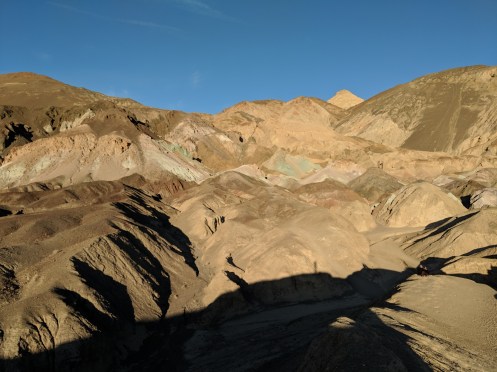 While Death Valley doesn’t have lots of colored foliage, it does have lots of colored rocks. Even just driving around you can see lots of colors, striations, and rock types, but to see lots of colors in one place you can take Artist’s Drive to Artist’s Palette. We actually visited it twice, once during the middle of the day and once at sundown to experience how the rock changed color with the different angles of the light.

And right near Artist’s Palette is another filming location from Star Wars; R2-D2 passes down this arroyo before being captured by jawas. Plus it’s pretty.
While the most popular locations in the park are accessible by paved or dirt road, to really explore the park you’d need an off-road vehicle. We were somewhat surprised to learn that Death Valley only became a National Park in 1994, and with the visiting season somewhat limited it may not get as much investment as the other national parks. As a result, getting off the beaten path means more there than it does it other parks. Now that we’ve seen the major destinations, if we go back we’ll definitely have to rent something more rugged to explore more out-of-the-way places.

We got our latest issue of Milk Street magazine recently, and this week we’re making a couple of recipes from it. Tonight we made the steak and bacon tacos, which in theory is Mexican (tacos de alambre), but it’s hard to escape the suspicion that it’s pandering to the crowd. Bacon in tacos? Seriously?
The recipe is, of course, delicious. It’s hard to go wrong with steak, bacon, peppers, onion, tomatoes, and melted pepper jack. And it’s part of their Tuesday Nights series, so it’s relatively easy to make too.

We caught Cirque du Soleil’s Volta show last night. It featured many of their stock elements (Trampolines! Aerialists swinging from lines! BMX riders!), but it was still a fun time. Even their stock elements are a lot of fun, but they had a few interesting twists in this show. The strongman did lifts with his partner while riding a unicycle, which looked crazy hard. And one of the aerialists did her routine suspended by her hair (they ran a line presumably to a ring in it), which just looked like it could be incredibly painful.
The music was also good but kind of generic Cirque; there wasn’t anything particularly memorable about it. My favorite music of the shows we’ve seen recently is still Luzia; its music had a bit of Mexican influence, which to my mind made it stand out more.
Definitely catch the show if you have the chance; it’s good fun.

I’d meaning to try Libby for awhile, but every time I thought of a book I was interested in reading it seemed like there was a 4 week waiting list for the book (Sunnyvale draw on the Northern California Digital Library, whose collection seems a little hit and miss). Libby is an update on Overdrive, which was thoroughly mediocre as a reading app.
A couple of weeks ago, though, I was perusing the local book store and David Eggers’ Monk of Mokha caught my eye. I decided against getting it then, since I was still reading a different book. When I finished that book, however, I thought to check Libby, and lo and behold they had a copy available. Overall I found Libby a significant improvement over Overdrive as a reading app; it was fast, responsive, made it easy to search and navigate, and offered both light and dark modes (useful when you read both outside in the sun and at night in the dark). I’d definitely use it again, the next time NCDL has a book I’m interested in available – when I finished Monk of Mocha I tried to find something else to read, but they all had four week waiting lists.

We’ve been the recipients of a Pineapple Express in the Bay Area this week; with the possible exception of Monday, I think it at least sprinkled every day this past week. And some days we got some pretty serious downpours. We’re out of drought conditions here, so that’s good. But I must confess that I’m getting a little tired of all the rain.
There are some upsides, though. Aside from getting us out of drought (which is always good) and refilling our reservoirs, most days we’ve had a series of showers and rain spells rather than a steady, ongoing rain (although we’ve had some of that too). That’s meant a lot of rainbows. I happened to catch this one while working near a window at Google today, but I’ve seen four or five others on different days over the last couple of weeks.

We almost never make pork chops; my wife isn’t really a fan. But I received Milk Street’s Tuesday Nights cookbook (highly recommended) as a Christmas gift, and we’ve been working our way through some of the recipes that haven’t appeared in the magazine (also highly recommended). I do like pork chops, so I was curious to try their pork chops with peanut-guajillo sauce recipe (I’m also a fan of peanuts, toasted guajillo peppers, and chili powder).
The meal turned out very well; the chops were tender and the sauce was very tasty (and it also went well with the roasted potatoes we had as a side). As a bonus, the recipe makes enough sauce that you can really use it across two meals, so we’ll be making this recipe again soon.
I do find it interesting to see the difference in ingredients between the average Milk Street recipe and the average Cooks Illustrated recipe. Both feature staples like garlic, cumin, coriander, chili pepper, etc. But Milk Street seems to be very big on grated ginger, honey, paprika, miso, and agave syrup (among others). I put it down to the stronger Asian influence on Milk Street recipes. And I appreciate the difference; we’d been finding fewer and fewer interesting things to cook in Cooks Illustrated, but we regularly find new recipes we like in Milk Street.
I’ve been using Kotlin at work for roughly two months now, doing most of my prototyping in it. I wouldn’t say that I’m fully acclimatized yet; I haven’t yet acquired habits that allow me to fully leverage the language’s capabilities (what is the Kotlin adjective that’s equivalent to Pythonic, anyway? Kotlinesque?). But I’m sufficiently fluent that I can quickly knock out experimental prototypes without having to keep going back to the language reference.
Overall switching to Kotlin has been a positive experience, and I’d recommend that anyone doing Android development switch to it over Java (particularly since you can still take advantage of all the Java libraries thanks to interoperability).
But there are a couple of things about the language that are a little irritating, particularly when I’m coding up prototyping that are exploratory and that I’ll eventually throw away. And the reason is that Kotlin is structured to help developers avoid making errors:
- You need to explicitly declare that a variable can be null, and if it can be null, then anytime you use it you need to verify that it’s not currently null. That approach makes null pointer exceptions much less likely.
- You need to initialize variables when you declare them, so that you don’t accidentally access them before you initialize them.
- You need to explicitly coerce your types; no implicit coercion between integers and floats for you. That can be useful to help make sure you’re assigning the right values to the right variables.
But while those characteristics are useful for writing production code, they can be annoying when writing throwaway prototype code. Yes, my variable pointing to some View in my Android prototype might be null. I know it’s not. I’m willing to risk the null pointer crash in a throwaway prototype. And Views in Android? Not available when you instantiate an Activity or Fragment; you have to wait until Android gets around to actually creating them at some point after instantiating your class. That makes initializing some of your variables problematic. And when experimenting with interactions I’m often switching between pixels (integers) and interaction coordinates (floats). I’d like automatic coercion from integers to floats in exchange for my agreeing that I’ve voided my warranty.
So Kotlin isn’t perfect. But then again, no language is. And like I said, it’s preferable to Java. The first time I could doOnEnd {} to an animator (something I need to do all the time), I was totally sold. So you should definitely consider the switch too. Just remember to explicitly coerce your types.

Six years after our initial visit we finally made it back to Alcatraz. My wife’s father was in town, and since he’s interested in all sorts of history we took him to Alcatraz. We still didn’t manage to make it to the island early (our daughter had her first cavity filling, so we couldn’t catch a boat until the afternoon), but with the partial government shutdown I think they’d canceled all the walking tours anyway. Maybe next time (and I still think it’d be fun to do a night tour).
Visiting the island is still fun: history, views of the bay, nature and wildlife. This time my daughter decided to get her own audio guide; last time she didn’t grab one, but then ended up monopolizing my wife’s shortly into the tour. So this time both of them got to enjoy the whole audio tour.
My front derailleur cable started to fray last week, so this week I took advantage of Google’s on-site bike repair (they have a couple of providers, and I went through The Bike Doctor because I’ve gotten good service from them before).
I’ve only had to get my bike repaired a few times in the 10+ years I’ve owned it (a few frayed cables, replacing my brakes), and every time I’m reminded that one of the many benefits of riding your bike to work is the cost savings versus driving.
In California it costs me rough $40 to fill up my car with gas. An oil change typically costs $60. A tune-up plus associated small repairs? A couple hundred.
Replacing the cable on my bike and getting a general tune-up in the process? $70 and change. And that’ll pretty much keep me for another year or so, if previous patterns hold.
It’s good to bike to work.
File this one under “Things I did not see coming”: Apple signed a deal with Samsung to include iTunes on newer Samsung TVs.
Makes sense in retrospect: if Apple is really trying to push Services revenue, allowing people to watch iTunes content on more devices is a logical approach. Still, it’s interesting to see Apple going with a software licensing deal rather than pushing their own hardware; I wonder what the Apple TV team thinks about the move?
 jeff pierce