So I was randomly trying to find a talk announcement for a talk I gave several places awhile back (sad to say I was trying to find it to grab and reuse the bio blurb I used for some of them), and I discovered that a talk I gave way back in November 2006 at Stanford entitled “From Personal Computers to Personal Information Environments” is up on YouTube. Who knew?
A big thank you to the two people who gave it high ratings. =)
In a world where Don LaFontaine recently passed away, I decide this YouTube video was too good not to share. Although having watched a number of Disney videos recently with my daughter, the inclusion of their voiceover guy weirds me out a bit.
Plastic Logic’s new electronic document reader looks interesting. I’ve had a Kindle now since around May or so, and I have to admit I really like the convenience of the device. It’s become my primary reading medium; the only printed material I seem to read these days are magazines that aren’t available on the Kindle and technology manuals (I’m leaning Cocoa now, and I couldn’t imagine browsing a manual and examining code through an e-book reader; way too painful). But there is room for improvement, and competition among hardware vendors is a good thing for driving the field forward. I’m interested to see what Amazon comes out with for their hardware refresh as well; the latest rumors I heard were next year.
The New York Times has more on the Plastic Logic reader.
For the seond year in a row we’ve finished off our summer camping season with a weekend camping trip to Half Moon Bay State Beach. The camping spots themselves are nothing fantastic (they’re all out in the open, so you get zero privacy), but the location is great: just a hundred or so yards from the ocean). And it was particularly nice this year; while San Jose was baking with weather in the 90s, Half Moon Bay was in the low 80s.
The trip got off to a somewhat slow start; we got stuck for 30 minutes at a dead stop for an accident that closed 92. Strangely enough the exact same thing happened last year on our camping trip. Either 92 gets cut often by accidents on Friday afternoon / evening, or we have weird luck.
Aside from that small bump, the trip was lots of fun. Good weather, lots of time playing at the beach, and some tasty food. To cap it off there was a whale (at least one) and some dolphins or porpoises that came as close as a few hundred feet off the beach Saturday evening (like following a school of fish). It was great watching them as the sun set.

After listening to the Republican convention speeches on NPR yesterday, I’m left wondering whether the Republicans are idiots or they just think we are. Speaker after speaker lambasted the federal government, complaining about such issues as ballooning federal spending and “liberal” decisions by the Supreme Court, such as the one permitting rights to the Guantanamo detainees. They’ve apparently forgotten, or desperately hope that we will, that the president is Republican, and that up until the last couple of years Congress was dominated by Republicans as well. That ballooning federal spending? Their fault. Recent decisions by the Supreme Court? Last time I checked, the majority of the current Justices were appointed by Republican presidents. Threats to America overseas? The Republicans have had 7 years after 9/11 to turn things around; what’s their excuse for why we’re not safer?
I can’t decide which of the following is true:
- The Republicans are idiots and fail to realize that by ranting against the government they’re essentially telling voters not to support those running the government, namely themselves.
- The Republicans think we’re idiots and believe that if they tell us that we should elect a Republican president to clean up the “mess in Washington” we’ll somehow forget they caused the mess in Washington.
Either way they’re doing a miserable job of convincing me I should keep them in charge for 4 more years. And I used to at least respect McCain.
The fine folks working on Django have (after being on version 0.97 for what seems like forever) thrown the switch and released 1.0.
I’m totally biased, having used Python throughout much of graduate school and even beyond, but I’ve played with both Django (the 0.97 release) and that other framework (version 1.something, so admittedly not the latest and greatest) and personally I think Django is better. So I’m happy they’ve finally made it to 1.0 status, and look forward to 1.1 in the not-too-distant future.
If you need further proof that Google plans for Chrome to be a virtual machine for running web applications just as much as a more traditional browser, just do the following:
1. Visit one of Google’s web apps (e.g. mail).
2. Click the little “Control the current page” pull down menu and select “Create application shortcuts…”
3. Choose where you want Chrome to create shortcuts and click “Ok”.
4. Poof: a shortcut appears and the browser controls (Omnibar, next and back buttons, etc.) disappear. Funny, doesn’t that web app now look very much like a traditional desktop app? In fact, the only control that really shows you’re still in the browser is a little pulldown menu that appears in the top left of the window border.
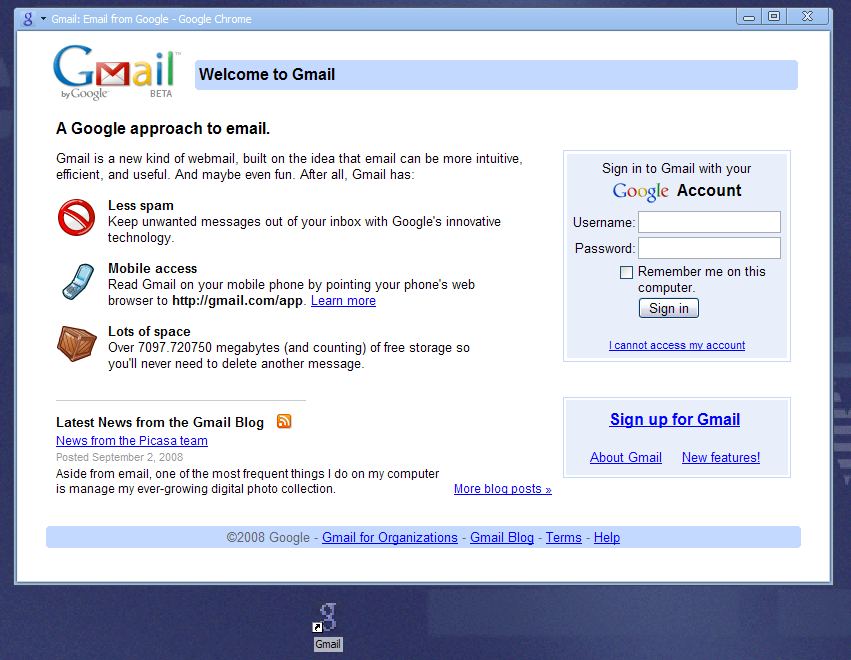
Obviously that’s not a new idea; Mozilla’s Prism is playing in the same space. But Google’s trying to make it part of the basic browser functionality in order to help drive adoption of web apps. It’ll be interesting to see if they succeed. I’m not a heavy web app user (I do use several web services, but I primarily use them through desktop applications; I’m posting this through ecto), but I do know folks who are. I’m curious whether they want an experience that is more like a desktop app or one that more closely embraces its browser roots.
When I was faculty at Georgia Tech, I had an office that overlooked the interstate. And Midtown Atlanta, where my building was located, is not particularly scenic.
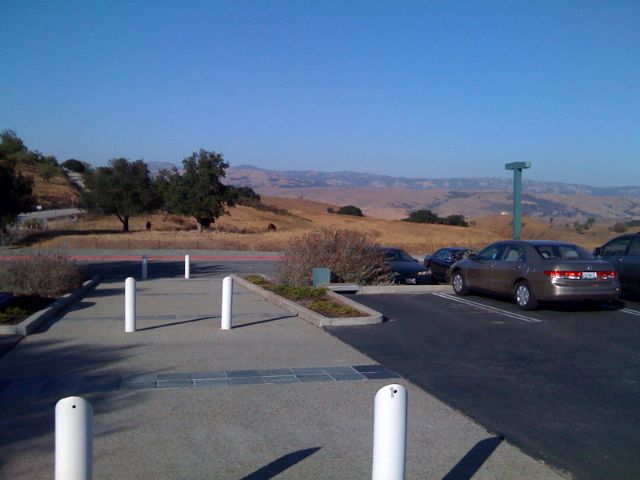
So one of the things I enjoy about IBM’s Almaden Research Center is the setting. The lab is up in the hills between Santa Teresa and the Almaden Valley at the Southern tip of Silicon Valley. It’s surrounded by a mix of park land (which IBM donated) and land that IBM owns. Not only is it pretty, but I see wildlife all the time: deer, turkeys, coyote, feral pigs, and rattlesnakes. And then there are occasionally the cows: IBM leases the grazing rights around the lab, and I find it highly amusing to pass by cows while entering a high tech facility. There are even, I kid you not, signs on the walking trails around the lab that say “Beware of rattlesnakes and cattle”.
I have to admit, when I first heard that Google is releasing their own browser my first reaction was, “Who the heck is herding those cats?” In a world where IE 6 still has more market share than Firefox (which has been out how long?), do they really think they can dethrone IE? (Amusingly enough a poll in the SJ Mercury News shows that people in Silicon Valley think they can, which just goes to show how much of a bubble we live in.)
But then I went and read Scott Adams’ comic on Chrome, and what Google is doing became clear. They’re building a virtual machine for running applications that’s disguised as a browser. Multiple processes? Check. Memory management? Check. Fast code compilation and execution? Check (in theory). Improved security model? Check (again, in theory). In fact, what the comic reminded me of most was a discussion a colleague and I had last summer about how the browser was becoming a virtual machine that treated the Internet as a first class citizen (something the Java VM failed to do).
Seen in that light, Chrome is a logical move for Google to make since, let’s face it, web app capabilities are still a shadow of native app capabilities. And neither IE nor Firefox are moving things in the VM direction particularly fast. And since Google needs us to go there (otherwise Google Docs will continue having a hard time competing with Microsoft Office), it makes sense that Google is now trying to push the browsers there.
That doesn’t mean I think they’ll succeed anytime soon. I already have enough browser in my life: Safari, Firefox, and (occasionally) IE. I don’t need another one, particularly one that’s going to have fewer features than the others for the foreseeable future. While I think Chrome is an interesting idea, I don’t therefore plan on installing it (it doesn’t help that the beta is Windows only, and I spend most of my time in Linux and OS X these days). My personal bet is that they’ll get more traction trying to get other browsers to adopt their ideas, but even that’s going to be a tough sell. Never underestimate the inertia of deployed code.
Still, it’ll be interesting to watch.
Aza Raskin has been keeping busy. Mozilla announced an early prototype of Ubiquity this week. They bill it as a command line for the web; if you’re a Mac user, think of it as somewhat like Quicksilver or LaunchBar. You can use a special key combination that will let you start typing a command, with the tool suggesting likely completions and executing whatever command you specify. There’s an obvious lineage here from Enso, Aza’s previous work, although the shift from the Windows desktop to the Web is an interesting one that arguably opens more opportunities.
The early examples are a little simple (why do all mashups seem to center around maps?), but they hint at some possibilities that could be quite intriguing down the road (although for me to really start using it they’d have to tie in with my desktop apps; I like web services, but I’m not a all-web-all-the-time convert). It’ll be interesting to see what they (and others) do with it.
 jeff pierce