A colleague pointed out this mistaken translation earlier this week, and they actually mentioned it on NPR’s Wait Wait, Don’t Tell Me as well. It’s a restaurant sign that says “Translate Server Error”, implying that the restauranteur plugged in his restaurant name to some online translation service and didn’t realize he’d gotten back a bad result. However, I prefer to instead think that the restauranteur is in fact a marketing genius that realized how much free extra press he’d gain from a silly “translation”. How many people do you think will track down his restaurant in China just to see the sign and get their own picture? If only a fraction go in and buy something, he’s still way ahead.
Silicon Valley is dry. Seriously dry. Haven’t gotten any real rain since
January dry. So you’d think that people might grasp that now might be the best time to be tossing their cigarette butts out the window. And yet I’ve started to notice suspiciously positioned burnouts from brush fires. There’s one by the Great America parking lot near the trail where I bike in the mornings. And this morning firefighters were putting out a small blaze where 87 exits from 101 as I went by to drop off my daughter at her preschool.
Sometimes it’s a little too obvious that people don’t think.
The Outstretched Shadow is yet another of the books that Tor made available free to Kindle owners. There’s an obvious trend here; all of the books that I’ve read so far from the set they gave away have sequels, so Tor is obviously following “the first one’s free” rule of marketing (which is really easy to do with the Kindle, since duplicating electronic content doesn’t cost Tor anything). Although side note to Tor: that ploy is more effective if the sequels are also available for the Kindle.
Anyway, the Outstretched Shadow is the first in a trilogy, although it ends at a sufficient point of closure that you’re not left hanging as to what happens to the protagonists. It’s yet another take on the young-man-with-hidden-powers-he-later-discovers genre, although the way Mercedes Lackey and James Mallory (co-authors, always a worrying sign) have structured their world is somewhat novel (different types of magic, each with a different sort of price to use). The overall plot is sufficiently engaging that I read it all the way through and a couple of times read later than I intended to find out what happens next, but the book has a major flaw that may keep me from reading any of the other books in the trilogy: it’s repetitive. Somewhere around the 20th time the main character has an angst ridden moment about whether it’s worth using magic you start wishing someone would slap him upside the head. The book could have used a stronger editor who would’ve pushed the authors to tighten the book up more; it could easily be 1/4 shorter without affecting the plot at all.
But I must admit that it was a rather fun read. Particularly when you got it free.
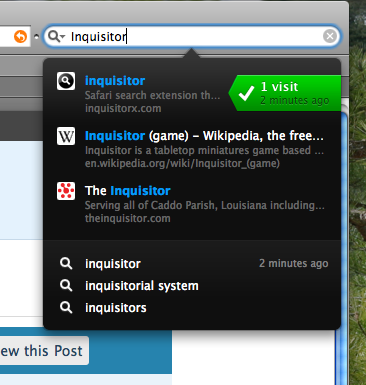
Ok, I completely admit that I looked at Inquisitor because I saw a mention describing it as a Safari plugin from Yahoo!, which is where my wife works. And I installed it because (a) a quick Internet search revealed positive comments and (b) it irks me that Google is the default search in Safari. But after playing with it for a bit, I must say that I like it. It does a good job of both previewing results and suggesting matches that you’ve visited previously (something I also like about the Firefox 3 address bar). If you use Safari on OS X, I recommend checking it out yourself.
I finished Sun of Suns, the second of my free Kindle books from Tor, on my flight out to Boston. Overall it was also rather good, although in a different way. While Old Man’s War was an enjoyable story, Sun of Suns is notable more for the world that Karl Schroeder creates than for the plot itself (which, while swashbuckling sailors with wooden boats in zero G in a giant enclosed sphere are fun, is a little flat). But hey, swashbuckling sailors! Pirates! Multiple freefloating towns inside an air-filled hollow sphere! What’s not to like, in a ok-it’s-still-summer-and-I’m-happy-not-to-think-too-hard kind of a way?

During my latest trip to Boston I thought I’d experiment with renting a movie on iTunes and watching it on my iPhone on the flight out. Overall, I have to say the process was pretty smooth (in fact, smoother than I expected; I was a little concerned that it’d start the 24 hour clock as soon as I transferred the movie to my phone). The worst part was downloading the movie itself; with a DSL connection it took nearly an hour, and the download was not improved by my laptop deciding to sleep partway through the transfer (that would seem to me like an obvious no-no, but then I’m not an Apple designer). Otherwise transferring the movie to my iPhone was dead simple, the iPhone iPod UI clearly identified how much time left I had on the rental (both the number of days before watching it and the number of hours once I started), and the iPhone didn’t start the countdown until I actually started watching.
In short, the $4 experiment worked well. I’ll definitely be renting movies on future flights (with a small child watching movies on flights is one of the few ways I actually see contemporary movies).
More and more the airline industry reminds me of the music industry. Both seem cultivate an attitude of hostility: the music industry treats all if it’s customers as pirates, while the airline industry vaciltates between treating all of its passengers as potential terrorists and acting as if we should all be grateful that they’re willing to fly us at all. Both project the aura that we should really just be willing to hand over our money without expecting any service at all. I can’t help but wonder how successful an airline would be that gave people the impression that it was actually happy to be of service. I’m certainly not surprised that most of the airlines are hemorraging cash; the greater miracle is that they’re still in business at all.
This little jaunt (where sadly I’m going to spend more times on planes than I did in the meeting I actually traveled for) reminds me why I avoid business travel in the summer: tourists. Summer is when all those people who only fly once every five years fly, and the combination of their uncertainty as to what to do and the airlines’ hostility to travelers is never pleasant. The check in line was moving extra slow this morning because of passengers who failed to realize that the self-service kiosks required self-service, and I’m pretty sure that some of the folks in the security line had never been through security (at least during the TSA’s “just do us all a favor and stop traveling” regime).
And then there’s the new airline policy of making people pay extra to check bags. The best part about it is how the airline staff seem genuinely surprised that boarding now takes extra long because everyone is trying to cram extra luggage into the overhead compartments. You didn’t have to be a genius to see that one coming.
What is it with companies that they bypass the “cool” and “cold” settings on their thermostats and go straight for “deep freeze”? I’ve spent most of the day in a conference room that was at risk of giving I’d hypothermia (until we found and adjusted the thermostat ourselves).
Is it too much to ask that companies either:
1. Raise the temperature on the thermostat (simultaneously making people more comfortable and saving energy).
2. Let us open the windows to take advantage of some of the global warming caused in part by their super duper über powered AC.
At this point I’m willing to accept either solution.
Interesting; free software that allows you some measure of control over how much energy your PC is consuming. Could be a useful tool to let you configure your PC to draw less power for those times when you want it to be available but don’t expect to be using it actively.

Edison's user interface
 jeff pierce