Prominent players in the mobile ecosystem would really like it if you’d stop using cash and credit cards and instead used your mobile phone to pay for everything. On the ride home from work yesterday I caught a Commerce Weekly article from O’Reilly that in turn points to an article from ReadWriteWeb on Revolutionary Technology & The Transformative Effect On Currency. Did you know that smartphones might transform our society from cash-based to digital?
Ok, first, I’m not sure I buy (sorry) that our society is still cash-based. Credit cards have been around for years; aren’t they already hard at work transforming commerce into an exchange of information rather than an exchange of actual physical cash?
Second, given that most people already have multiple credit cards they always carry with them, what makes people think that offering the opportunity to use their phone to pay (which they also always carry with them) will somehow make them give up cash? What’s that you say, that swiping a credit card is too much work (uh, as opposed to pulling out cash?)? Ok, then why did all those physical proximity credit card payment options fail? People do remember those, right? (It does occasionally seem like pundits have astonishingly short memories.)
So what’s really different about mobile wallet solutions? Let’s see what ReadWriteWeb says.
- [T]he consumer gets the value of electronic receipts and the ability to receive coupons, offers and loyalty rewards. Ok, none of that is new. Credit card companies already offer similar things.
- [T]he retailer knows who that person is. Also not new. Pundits do realize that credit cards have names on them, right?
- [T]he mobile wallet provider gets information about what was bought when and where and by whom. Ding ding ding ding ding!
There you have it, the real motivation for the mobile wallet push. Mastercard and Visa are getting all sorts of data about where and when you’re buying things, and other entities want that information: Google, the mobile carriers, etc. In other words, mobile wallets aren’t necessarily better for you (in fact, they might be worse depending what regulations end up governing the use of information about your purchasing behavior), but there’s a lot of money potentially available from being in control of the flows of information.
So hop on the mobile wallet bandwagon and become a better product today! Advertisers are waiting to pay for information about what you’re purchasing. They’re just not waiting to pay you. Sorry.
Mid-August we took a trip up to Bodega Bay in Sonoma County. We’ve slowly been crossing things off our list of things to do as good Californians (which we’re sadly quite behind on), and one of those things is a visit to Wine Country. Visiting a ton of wineries isn’t high on our list of things to do with a child, so instead we choose the coast and exploring some of the smaller towns in western Sonoma.
Bodega Bay, for those who aren’t up on their Hitchcock, was the setting for Hitchcock’s The Birds. But we crossed our fingers that they wouldn’t overdo the link and a booked a room at the Inn at the Tides. Of course, it helped that we decided to go on relatively short notice and there weren’t many other alternatives available…
Overall we were pleased by the hotel. While not trendy and fashionable, it was comfortable and well-located, with a nice view of the bay. Plus it was right next to a pasture with cows. Who doesn’t love cows?


Bodega Bay itself was cute but small. Aside from a few restaurants and stores there wasn’t a lot of there there. Although we did have a dinner and complimentary breakfasts at The Tides restaurant (it’s associated with the hotel). The food was good (they get fresh fish right off the fishing boats), but the view was better.


(Quick mobile device note: I brought my Galaxy S3 with me instead of my iPhone to see how it fared. Overall it did well, but I really missed having HDR for photos taken with the camera!)
Since Bodega Bay itself was smaller than we expected, we took the opportunity to scout out some of the other small towns in Sonoma as candidates for future visits. Duncan Mills had a bunch of fun shops to poke around, and we had an amazing lunch at the Cape Fear Cafe.


After lunch we headed on to Guerneville, where we walked around a bit and checked out the pedestrian bridge over the Russian River. The town had a very walkable main street, but there didn’t seem to be a lot to do besides float on the river itself. But there were a lot of people doing that, and it did look like a great way to spend a semi-lazy day.


We then headed on to Sebastopol, with a quick stop at Kozlowski Farms (their honey mustard is awesome). At Sebastopol we stopped by Copperfield’s Books, where we bought Anna a copy of the latest Judy Moody book (apparently Megan McDonald lives in Sebastopol; who knew?), and Sonoma Chocolatiers, where Kate bought a variety of tasty treats. After that we headed back to Bodega Bay. Our initial impression of Sonoma: my but there are a lot of small towns.
For our second day we decided on a lazy trip down Route 1 before eventually returning to San Francisco. We had two goals for the day: visiting Cowgirl Creamery in Point Reyes Station and the Point Reyes National Seashore. We accomplished the first right around lunchtime, and I must say that their ham, Mount Tam, lettuce, and Dijon mustard sandwich is amazing (my daughter agrees).

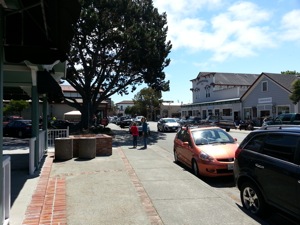
After buying cheese to take home we then headed over to Point Reyes. Since we’d never been before we stopped first at the Visitor’s Center, and then decided heading over to the Point Reyes Lighthouse sounded like the most fun (particular given that our daughter was not up for a long hike that day). The drive to the lighthouse was pretty but foggy as we got closer to the coast, and also rather surprising: who knew there were so many grandfathered ranches in the National Seashore (hint: not us)?
The area around the lighthouse itself is supposed to be a great place for whale watching in the winter and early spring, but it was rather hard to tell: in the summertime it’s apparently usually foggy, and it certainly was that day.

But the short hike to the lighthouse itself was fun (but windy; apparently they’ve measured winds over 110 MPH at the lighthouse, although it was only 35-40 MPH on the day we visited), and I enjoyed seeing the lighthouse itself. And from the lighthouse you could actually see down to the ocean below. I’d like to come back in the early spring when it’s apparently much clearer and actually try to see some gray whales (April is apparently a good time, particularly to see calves).


Overall the trip was a lot of fun, but I’ll confess that Sonoma was different than I expected. Next time I’d be curious to see some of the bigger towns (Healdsburg, Petaluma, etc.) to see how they compare. And of course once our daughter is older it’d be fun to visit the wineries as well…
The HCI research community occasionally gets excited about foldable displays (displays can be really big for ease of interaction, but still easy to transport: just fold it up and stick it in your pocket!), but I have to confess that I’ve always been rather skeptical (shocking, I know). In particular, I’ve always been curious how foldable displays would actually deal with, well, folding.
A common analogy researchers draw is with newspapers: it’ll be just like a newspaper, which you can fold and unfold depending on whether you want to read it or carry it. But if you fold paper enough times it’ll fall apart. And even with more rigid materials the hinge is typically the weak point (laptop hinges being one case in point, and my impression is that one of the issues with many of the more adventurous tablet PC designs that Microsoft showed off was the physical strain caused by folding). So I’ve always been unclear on how well foldable displays would actually work: sure, folding them would be cool, but who’d care if they fell apart after 50 folds?
But I’m the first to admit that I’m not an expert on materials science, and apparently scientists have made progress in dealing with the issue. A little digging turned up an article talking about work at the Samsung Advanced Institute of Technology (amusingly enough; I hadn’t intended this to be a plug for my employer) on foldable displays where they’ve run a display through a 100,000 fold/unfold cycle:
The researchers tested the foldable display’s mechanical and optical robustness by performing 100,000 folding-unfolding cycles, and found that the relative brightness at the junction decreased by just 6%. Since this difference is hardly recognizable by the human eye, the deterioration is considered negligible. As the researchers explained, the key to making a display with no visible crease involved controlling the optical properties of the materials.
Ok, I’m not sure a decrease of 6% is really “negligible”, but considering I would have expected complete hardware failure it actually doesn’t seem that bad. So maybe there will be something to foldable displays after all.
I have to confess I find WordPress comment spam entertaining. When I set up this blog I decided to enable comments but moderate them, expecting that most comments would be spam attempts rather than anything actually germane (because, let’s face it, it’s so much easier to dash off a quick reply or comment in Twitter instead of going to the trouble to post a comment). But as a consequence, I do occasionally have to go in and check my comment spam to see if a real comment was miscategorized. And as a result, I occasionally get a glimpse in the latest start-of-the-art for comment spam.
My comment spam these days falls into two categories. The first is rather uninteresting; it essentially throws a bag of words into the comment and hopes that it’ll sneak past the spam detector. News flash to spammers attempting this route: the detection routines aren’t fooled.
I find the second category more interesting. I’d label this category “attempted spam through ego-stroking”. It generally takes the form of a short comment along the lines of “thanks for posting, I found this really insightful”, hopefully that the blog author is so desperate for praise that they won’t look closer and will let the comment through. The spam authors will sometimes sneak a link in, other times they’ll try to put the spam in the author link, and in some cases they’ll avoid anything overt at all in the initial comment (doubtlessly hoping that the blog author will have configured the system to automatically allow subsequent posts from authors with approved comments, so that the spammer can then go crazy with spam comments.
The first category is essentially a technological approach: the spammers are trying to get spam through by guessing how the spam detection algorithm works. In general that seems like a losing approach, as evidenced by the fact that spam in the category always ends up marked as spam. The second category, however, is much more clever. Spam in that category anticipates that it will be flagged as spam, and applies social engineering to try to get the blog author to pull the comment out of the spam folder and approve it. I suspect the hit rate is still rather low, but I bet it’s higher than for spam in the first category. And in general I think social engineering is a more promising line of attack; I’m curious what the spammers will come up with next.
I’ve been gradually ramping up the number of days that I bike + take light rail to work to the point where I’m generally driving to work at most 1 day a week. It takes a bit longer (it’s around a 15 minute bike ride + a 30 minute light rail ride, compared to 15-20 minutes driving), but it’s a much more pleasant experience. Instead of spending time sitting at red lights or putting up with traffic I instead get a bit of exercise and then some uninterrupted quiet time. And Silicon Valley drivers are much more polite to bicyclists than they are to each other, another benefit.
When I first started the commute by bike+rail, I took advantage of the WiFi on VTA to use my tablet both on the way to work and on the way home. But in the last month or so I noticed that I felt like I was still rushing on my morning commute, since I was trying to consume as much information as I could before I got to work. So instead I’ve been experimenting with restricting myself to pen + notebook in the morning, thinking about current and upcoming projects, exploring ideas, and sketching out possible designs and architectures.
So far it’s made a noticeable difference. By the time I get to work I’m ready to start my day since I’ve spent the last 30 minutes thinking about what to tackle next and what approach to take. And yet I’m relaxed, since I find brainstorming ideas with pen and paper very calming. Plus even on those days that are packed full I’m guaranteed at least 30 minutes of thinking time, which is always a good thing.
I do still pull out my tablet and use VTA’s WiFi network, but I do it at the end of the work day instead. On the way home I fire up Reeder and check out what else has been happening in the world while I’ve been at work. I find it a good way to pop up a level and keep on eye on broader trends. So while I’m not planning on joining the Slow Tech movement anytime soon, I’ve definitely found pen+notebook a better transition to my workday than tablet+WiFi.
Of course, either is still better than driving.
Sorry, I couldn’t resist the link bait-ish title. I’m a weak person. Anyway, after more than a month of using my Galaxy S3 almost daily, I’ve decided that the major issue I have with Android isn’t the lower quality of its applications (although the quality bar is definitely lower). No, what bothers me most is that Android sucks at power management.
Despite the fact that my iPhone 4 is now over 2 years old and the S3 brand new, I get a day and change at most from the battery on the S3. And sometimes I manage to suck the battery dry within a day. My iPhone 4? Still going strong at at least 2 days per charge. Some of that difference is due to the fact that the S3 has a 4G radio, which consumes more power. But even more than the reduced battery lifetime, what bothers me is the sheer variability in battery lifetime.
On any given day I’ll end up with between 40% and 60% battery left at the end of the day, despite no clear (to me) difference in my phone usage behavior or the time I spend in 4G vs. WiFi coverage. That’s a 20% range swing, and it doesn’t even count those days where the battery runs dry without any significantly different usage on my part either. That’s the difference between charging every day (60% usage in a day) vs. every 2 days (40% usage a day). On Sunday I was up in SF much of the day and ended up with 71% battery left, but after deciding not to charge up the phone ran dry by 5 PM today.
What do we know about people? They seek patterns to explain outcomes. And what do we get if there are no clear patterns to explain the outcomes? Superstitions. I’m halfway convinced that any time I run Google Maps it’ll cause my battery to run dry within hours, since the last-but-one time I ran Google Maps my battery ran dry well before the end of the day. Except the last time I used Maps it didn’t seem to have any impact on my battery, so maybe not. Or maybe it was because I ran a search. Or didn’t exit to the home screen before putting my phone away. Or maybe it was some other app. Who knows? Not me, because I don’t see any rational explanation for the extremely wide variance in my phone’s power consumption. Maybe it’s sunspot activity.
Regardless, I think what Android needs is Project Juice, not Project Butter. Because right now Android is training users that running apps is bad, because they may randomly suck your battery dry without any obvious cause. No wonder iOS users tend to use more apps than Android users.
I meant to comment on Fred Wilson’s In Defense of Free last week, but then got busy. Fred was largely reacting to Dalton Caldwell’s post arguing that we should pay for services so that service providers focus on our needs, rather on the needs of advertisers. I’ll preface my comments by saying that I largely agree with Dalton; I’ve lamented before that so many providers are focused on selling me as a product rather than selling me a product. I’d much rather pay for more services so that I know providers are working toward my interests.
In particular, I wanted to comment on this one paragraph:
Let’s start with advertising. I do not believe it is evil. In fact, I believe it is a fantastic way to support services that want the broadest adoption and want to be free. Think about the Super Bowl, the World Cup, the Olympics, the Oscars, the Presidential Debates, the news coverage of important events. These things are ad supported and free for anyone to watch who has a TV and an antenna. It is good for society for these things to be available to the broadest audience.
I agree with Fred that there are services where advertising is acceptable. However, I think Fred is being someone what disingenuous by focusing on TV as his example. Broadcasters sell TV advertising based on the expected audience for content. Specifically, the aggregate audience. As a result, I would argue that the advertising is not particularly intrusive, and I personally don’t have a problem with it.
However, today’s online services are centered around a more intrusive form of advertising: extracting as much personal data from you as possible and then using it to sell access to you as an individual, rather than you as an aggregate class. It’s that focusing on extracting and using personal data that I find objectionable. And because the more data about you a service has the more it can charge for access to you, providers have an incentive to continually push the boundaries to extract more and more data. Too much is never enough.
So I agree, free services aren’t necessarily bad (and the advertising used to support free services aren’t necessarily bad either). But the particular shade of free that seems pervasive on the Internet, trading our privacy for services, does seem bad to me (and others). So I wish Dalton and other like-minded individuals success in creating paid alternatives.
Ed Bott has a great article wondering “Why does the IT industry continue to listen to Gartner?” Former colleagues at IBM Research can testify that there were few ways to make me crazy faster than quoting a Gartner study to back up some point you were trying to make.
Why? Gartner is a giant echo chamber. As far as I can tell, they go around visiting a lot of tech companies and asking them what they think is coming up next. Then they write up a report summarizing what everyone just told them, call it “analysis”, and sell it back to the same companies they talked to in the first place. Those companies then proceed to quote the Gartner “analysis” as though it somehow provides evidence for whatever position they started out with in the first place. IBM did this in spades, despite the fact that as far as I can tell no one has ever actually done an audit to see how good Gartner’s track record actually is. From what I’ve seen the last few years, it doesn’t seem to be very good.
So until someone actually comes along, audits Gartner’s predictions, and concretely demonstrates they’re more reliable than a ouija board, I’m glad we have folks like Mr. Bott making tasty claim chowder.
Oh, and don’t get me started on the Gartner Hype Cycle. Talk about predicting the future of technology by throwing darts at a board…
P.S. Oh, and here’s why the IT industry listens to Gartner, in case you couldn’t figure it out from their process: it’s because they tell the IT industry what it wants to hear.
I’ve been using the Galaxy S3 for almost two weeks now, so I thought I’d share a few more thoughts on using it. Although this time around more of the thoughts are around Android than the Galaxy S3 itself. In fact, here’s my sole observation on the hardware: I find that I’m more willing to read content on the 4.8″ S3 than on my 3.5″ iPhone 4. I took my daughter to her ice skating lesson on Sunday, and instead of bringing along a tablet to read on figured I’d try reading off my S3. It worked better than I expected; since I could see more content per “page” I felt like I had to flip pages less and could concentrate more on the story. So I also like the larger form factor as a reading platform.
In general, then, I’ve been pleased with the S3 hardware. Android, however, still leaves something be desired. Not so much as an operating system, but as a platform. My biggest complaints:
-
Even when an application provider offers both iOS and Android versions of their applications, the Android version tends to feel like a 2nd class citizen for both look and feel. Where are the (non-Google) applications that are better on Android? I would argue that on iOS the best applications are not provided by Apple. But on Android? Google’s applications tend to provide the best experiences. I don’t regard that as a good thing, since to my mind it indicates that app developers aren’t competing to raise the bar.
Incidentally, I think the quality gap for 3rd party applications is going to reduce the impact of Jelly Bean. Yes, it increases the polish of the OS overall. But in general the operating system itself isn’t that bad these days (or at least Ice Cream Sandwich isn’t). Jelly Bean doesn’t tackle the biggest problem with the Android user experience: the fit and polish of the 3rd party apps.
-
For applications that are more about functionality than access to a particular service, I can’t find quality applications (even paid applications) that meet my needs. For example, on iOS I have a choice between several high quality applications to let me read feeds and manage my todo list (I personally prefer Reeder and Things respectively). Android? I can’t find an elegant application for either. I’ve thought about writing my own feed reader just to try to fill the former gap. For the latter I might be stuck hoping Cultured Code let’s a developer create an Android client that interfaces to Things Cloud.
-
Google needs a new revenue model. If Google offered a paid service, say for $10/month or $120/year, where they collect and mine my personal data and continually innovate to provide new and compelling functionality (such as Google Now), I’d happily cough up and eagerly cheer them on. Instead, I feel like Google is innovating new ways to collect my data and offer me up to advertisers (and yes, provide enough functionality that I keep coughing up data). And since Android’s best applications are made by Google and the operating system itself seems determined to send Google information (Would you like to enable WiFi position determination? You’ll just have to allow Google to periodically mine your location data…), I find myself focusing too much on what information might be collected from my use of the phone rather than just focusing on getting things done. I’d like Android a whole lot more if I were paying Google to work on my behalf. When someone else is paying them it’s too easy for them to make decisions that aren’t really in my interest.
Unfortunately, I’m not holding my breath on those issues improving anytime soon. I suspect I’m more valuable to Google as a product than as a customer. And Android users seem to be unwilling to pay for mobile apps, which means developers can’t make as much money as they can on iOS, which means Android is going to remain a 2nd class citizen for applications. At least for now.
I’ve now been working in the UX Innovations Lab at Samsung’s relatively new User Experience Center for almost two months now. While I’ve been an iPhone user since they were released, in order to get a better sense of Samsung’s current products I got a Galaxy S3 last week to play with.
The S3 is not my first Android device; we ordered several T-Mobile G1s (remember those?) and several Nexus Ones for my team to play with at IBM Research, as well as a couple of different Android tablets. But it’s the first one I’m going to try living with for a more sustained period of time (although I will also note that I’m not giving up my iPhone, at least not anytime soon).
I’ve only had the phone for 4 full days of use now, but here are some initial thoughts on it so far:
- First, while I initially thought the phone was going to seem way too large, I have to confess that I actually rather like the large display. Yes, it occasionally does seem a bit big in my pocket, but it’s only been a couple of times that I noticed. And when viewing or reading content the extra space is quite nice. Although yes, it does really require both hands to use effectively.
- One advantage of a removable battery pack? Replacing the removable back cover with a combo hard back + softer flip cover. I normally find covers for phones a waste (I carry my iPhone 4 without one), but I will confess (somewhat sheepishly) to liking the flip cover for the S3.
- After using an iPhone 4 for several years, my initial impression of the S3 (when borrowed briefly from friends to check it out) was that it was too plasticky and seemed cheap. But after using it for several days I’ve changed my mind. The use of plastic makes the phone lighter (my iPhone feels noticeably denser), but the phone still feels solid in my hand.
- Android still requires too much management. I can generally get through two full days with my iPhone before needing it charge it. When I first got the S3 I went through and turned on all the bells and whistles, and suck my battery dry before a full day was out. Granted I used it more on that day than I regularly use my iPhone, but still. After turning off most of the bells and whistles I now seem to be around a day and a half, which isn’t too bad considering the S3 is on LTE while my iPhone is only 3G. But still: I want to be focused on using my phone, not carefully calculating which functionality I can use without draining my battery too fast.
- The iPhone apps I use regularly are still noticeably of higher quality than the Android apps I use regularly. Even when they’re created by the same company. That seems to be particularly true for apps created by independent developers. iPhone developers seem to strive to build great experiences. Android developers seem to go with good enough. One of these days I’m write up a post trying to deconstruct why.
- Ok, this is a relatively minor issue, but I have to confess it’s driving me nuts. Someone explain to why the built-in iOS mail application configure out how to resize an HTML email message so that it all fits on screen, while the built-in Android email applications seem to be unable to do so? I don’t want to have to scroll an email message horizontally to read it; resize it so it fits horizontally and let me zoom in if I want to see more details! The only possible explanation I can figure out is that Apple has some patent in this space Google is afraid of treading on, although I’ve never heard of any such thing. Otherwise either they’re ignoring years of research showing that horizontal scrolling is annoying or they’re failing to sweat the small details (something Apple generally does well). Whatever the reason, I dearly hope they fix it.
So, bottom line? I like the hardware, particularly the larger form factor. Although I wish battery life was better. Android still has room for improvement. And 3rd party Android developers need to raise their game. Maybe at Google I/O next year Google should showcase a bunch of iOS apps as examples of good design to try to embarrass Android developers into doing better. But as a day to day device, the S3 is pretty usable. I’ll post more thoughts once I have more experience.
 jeff pierce